
Hudson got its start building shoes, not pipes. When the town was incorporated in 1866, it was already growing into a manufacturing center, and the homes that went up around the mills weren’t built with much thought for plumbing. People had private wells for water and outhouses out back. Where there was indoor plumbing at all, it was cast-iron drains and galvanized steel water lines — the best the era could do, and it was meant to last.
A lot of it’s still there. That’s the part the history books don’t tell you. Hudson’s sewer system expanded gradually through the late 1800s and into the 1900s, so the old cesspools and privies got replaced street by street, not all at once. And in the older neighborhoods, the original cast iron and galvanized is still in the ground and in the walls, doing a job it was never supposed to do for this long.
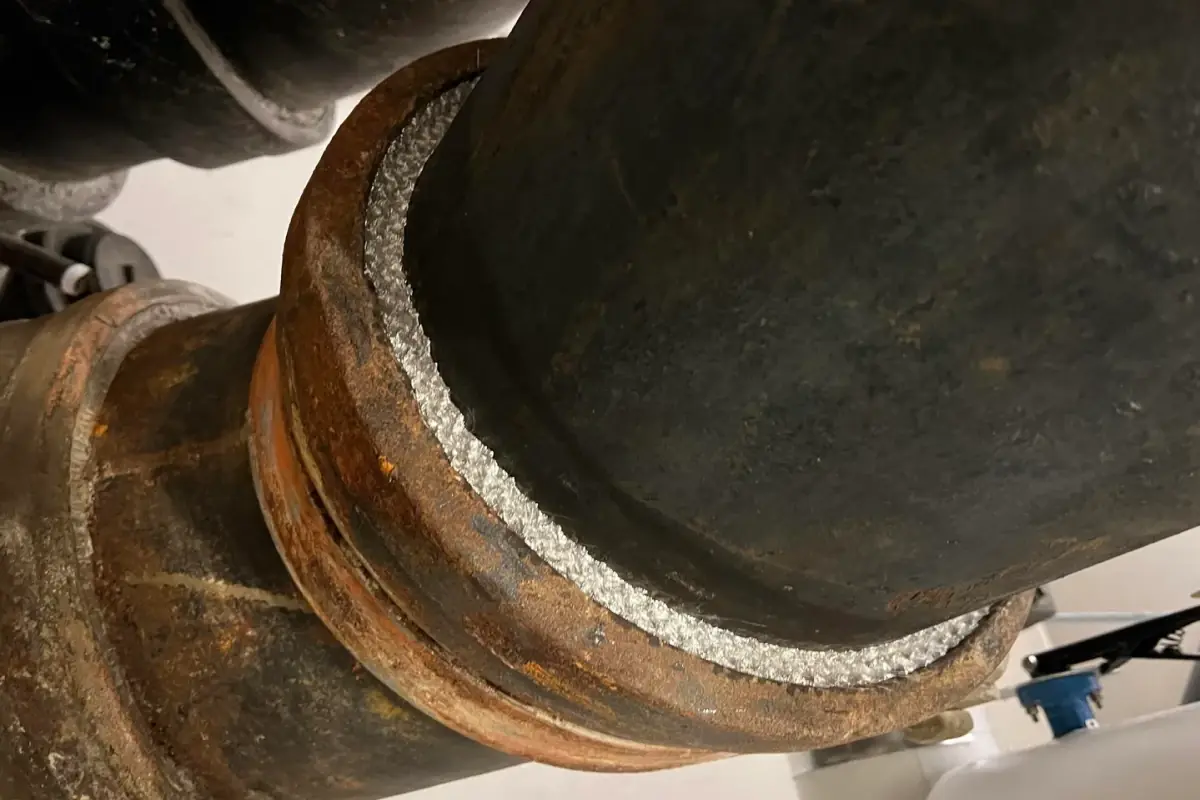
I’ve spent most of my life with my hands on that old stuff. I started working with my dad, Richard Sr. — I’m the junior, same name, same trade, and eventually the same name on the truck. Back then the job was different in a way that’s hard to explain to a young plumber now. If you had to join two pieces of cast iron, you didn’t glue anything. You packed oakum into the hub, melted lead, and poured the joint. Then you caulked that lead with a hammer and a caulking iron, like a chisel, until it was sealed tight.
My dad taught me how to do that. He was very old school. It took him years to switch to ABS and PVC drain lines — it had to be proven to him that it was a better way of doing things. Not just told. Proven.
And once we showed him, he went all in. A plumbing supply house was going out of business, and he bought them out. Three trailer truck loads of ABS fittings came into the yard, stuffed from floor to ceiling, front to back. For twenty years, we never had to buy an ABS fitting at all.
You don’t forget something like that. You also don’t forget your first PEX job, and I’ll tell that one on myself, because it’s the honest one.
By the time PEX came along, the tables had turned. My dad never did PEX. I had to talk him into it, the same way someone once had to talk him into ABS. So the first job I ran PEX on, me and my helper, I ran it the only way I’d ever been taught — straight and parallel, the way my dad always made us do copper. That was the mistake. We turned on the hot water, and within minutes every one of those lines had swung out of whack, all different directions, because PEX moves when it gets hot.
My dad just laughed.
That’s the thing about plumbing in this town. The houses changed, the materials changed, even the water changed. Hudson runs on a blended supply now — Gates Pond surface water mixed with groundwater from the town wells, treated to pull out the iron and manganese that used to stain everybody’s fixtures. In the old houses around here, that iron and manganese shows up in the original piping, and it does things to old galvanized lines that’ll make you wonder how the water ever got through at all.
But under it all, it’s the same town it’s always been. I still walk into houses with toilets from the 1950s — the kind with a tank ball, trip wires, and a guide arm inside. I fixed one the other day. And every once in a while I still find the even older ones, the 1920s toilets with the tank hanging on the wall and a flush bend running down to the bowl.
And I still walk into the older homes with the two kitchens — the working one down in the cellar, and the one upstairs that looks nice for company. That was the way a lot of houses here were built. The real cooking happened down below, out of sight.
A lot of plumbers today have never seen those, and never will. I’m glad I did. It’s why I still keep the old methods in my back pocket alongside the new ones — the poured lead and the PEX, the cast iron and the ABS. And it’s why I still run a stocked truck, the way I always have. Because in a town as old as Hudson, you don’t know which one’s waiting behind the wall. So I show up with everything.
If your old house has some of this stuff still in it, I’d be glad to take a look. You call, you get me.